Home » Real-time Radiation Belt Forecast

Real-time Radiation Belt Forecast

Real time forecast


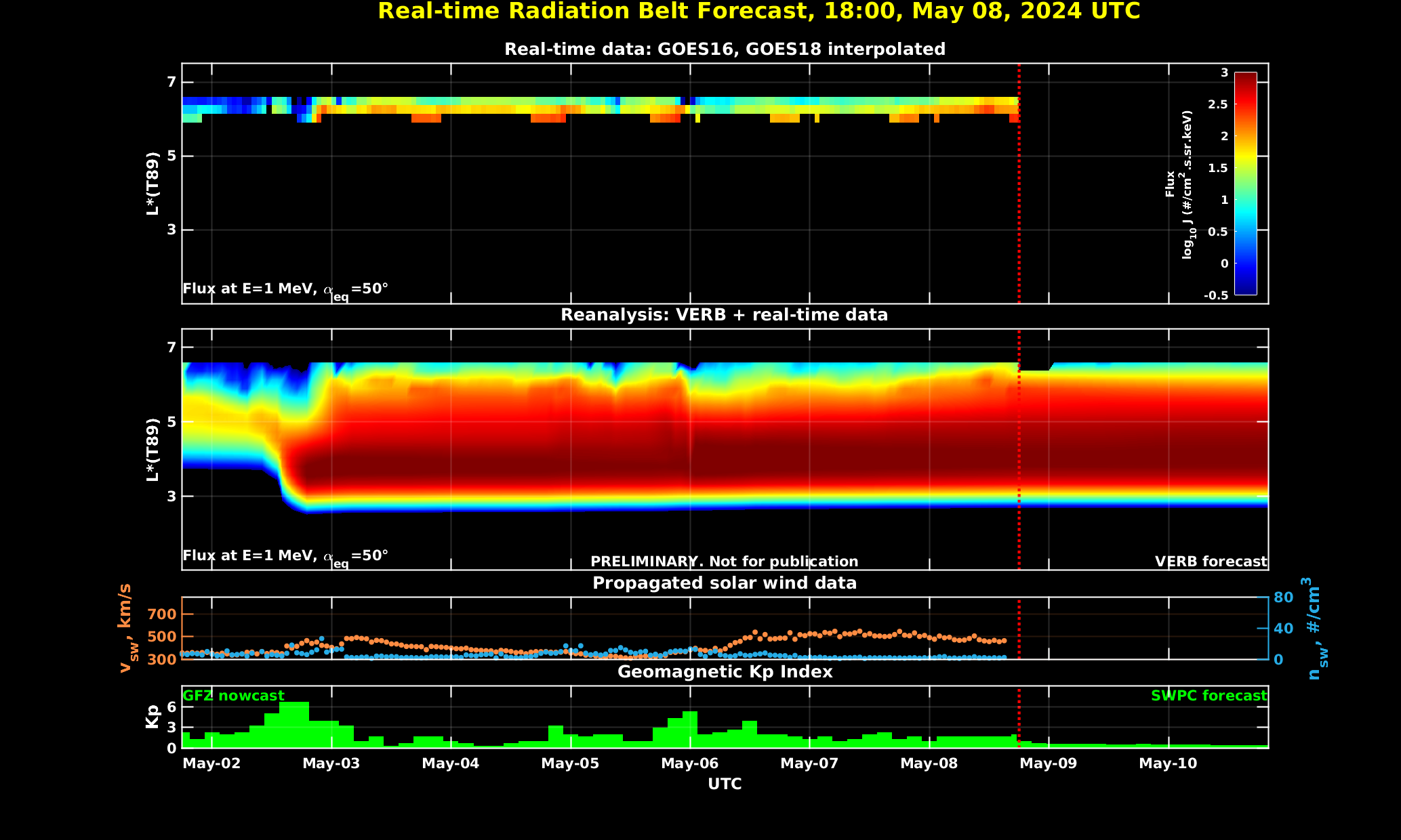
Two-day ensemble radiation belt forecast of 1 MeV electrons using the data-assimilative VERB code, real-time ARASE, ACE, GOES and POES data. Kp index for the previous 7 days is obtained from GFZ recent and previous month nowcast. 3-day ensemble Kp forecast is obtained from PAGER Work Package 3 (As a part of European Union’s Horizon 2020 research and innovation programme under grant agreement No. 870452 (PAGER)). Forecasts are conducted automatically every hour on Spacepager processing server at GFZ. The code computes the nowcast and forecast fluxes from reanalysis directly using the T89 magnetic field model.

Front page news

  • New findings on the electron ring current enhancement

    In the resent study, Bernhard Haas and co-authors found that the enhancement of the electron ring current during the geomagnetic storms is challenging to reproduce in the modeling, and it is attributed to a new missing scattering processes. Charged particles from space are captured by the Earth’s magnetic field. They then flow in a circular … Continue reading

  • Electrons approach the speed of light when plasma density is low

    In a recent study, Allison et al. found that depletions in plasma allowed electrons to accelerate to ultra-relativistic energies. The study used data from the Van Allen Probes as well as machine learning techniques to make these findings, which were published in Space Advances. “This study shows that electrons in the Earth’s radiation belt can … Continue reading

  • PAGER project started

    EU Horizon 2020 project PAGER started. The kick-off meeting held in Potsdam at GFZ. We’re excited to get our EU Horizon2020 project PAGER started! Kick-off meeting @GFZ_Potsdam pic.twitter.com/GNujSchUmT — spacepager (@spacepager) January 28, 2020 The PAGER project will combine models from the Sun to the Earth’s inner magnetosphere + ensembles of physics-based & ML models … Continue reading

  • Strong whistler mode waves observed in the vicinity of Jupiter’s moons

    In the vicinity of Europa and Ganymede, that respectively have induced and internal magnetic fields, chorus wave power is significantly increased. The observed enhancements are persistent and exceed median values of wave activity by up to 6 orders of magnitude for Ganymede. Produced waves may have a pronounced effect on the acceleration and loss of … Continue reading

  • Wave-induced loss of ultra-relativistic electrons in the Van Allen radiation belts

    A geomagnetic storm on January 17, 2013, provided unique observations that finally resolved a long-standing scientific problem.